A two-mass drive and elastic oscillations
Shaft compliance, natural frequency, damping, resonance and antiresonance.
Before you begin: rotational mechanics, referred inertia and pole analysis.
After this lesson you can: separate common and relative motion and verify the energy balance of a flexible drive.
Work through the explanation, examples, practical experiment and independent exercises.
From a rigid shaft to an elastic connection
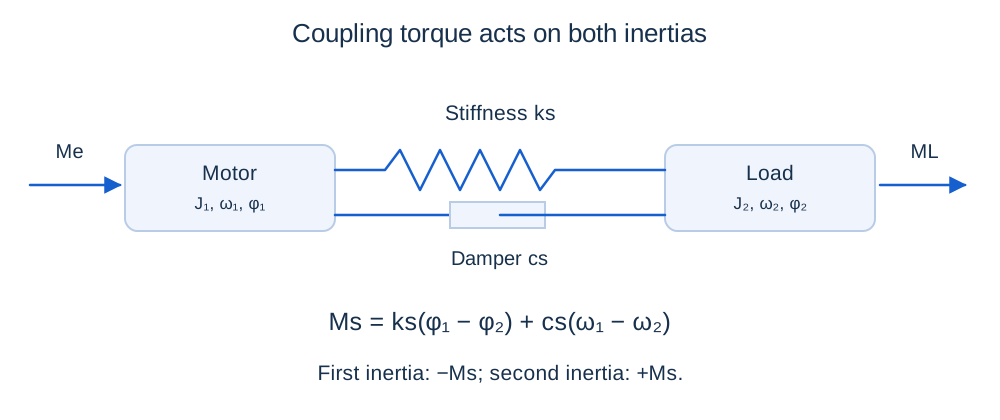
J₁ω₁′ = Me − Ms − b₁ω₁
J₂ω₂′ = Ms − ML − b₂ω₂
θ′ = ω₁ − ω₂
Refer both inertias to the same gearbox side. Positive coupling torque slows the first mass and accelerates the second. Its damper acts on relative speed, not speed relative to ground. Add i′ = (u − Ri − keω₁)/L and Me = kti for a four-state electromechanical model. Back EMF uses motor speed ω₁.
Common motion and relative oscillation
(J₁ + J₂)Ω′ = Me − ML
Jrθ″ + csθ′ + ksθ = [J₂Me + J₁ML]/(J₁ + J₂)
These equations set b₁ = b₂ = 0. The positive load sign in the relative equation reflects increased twist when the second inertia is braked. With no external torque, common rotation persists while relative oscillation decays if cs > 0. Damping relative motion does not necessarily stop the mechanism.
Frequency and damping
For J₁ = 0.002, J₂ = 0.008 kg·m², ks = 2 N·m/rad and cs = 0.008 N·m·s/rad, Jr = 0.0016 kg·m², ωr = 35.355 rad/s, fr = 5.627 Hz and ζr = 0.07071. Relative poles are −2.5 ± j35.267 s⁻¹. The envelope falls by a factor of 50 in 1.565 s; this is not a universal speed settling time. Critical damping is 0.11314 N·m·s/rad. Excessive damping can create a slow nonoscillatory mode.
Resonance, antiresonance and sensor position
Ω₂/Me = ks/{s[J₁J₂s² + ks(J₁+J₂)]}
These expressions omit damping, external friction and load. The motor-speed channel has an antiresonance at ωa = √(ks/J₂) = 15.811 rad/s or 2.516 Hz. A small motor-sensor amplitude does not mean the load is stationary. Damping smooths ideal zeros and infinite resonance. The integrator describes common free rotation: with nonzero net torque and no resistance, no finite speed equilibrium exists.
Energy and numerical validation
W′ = Meω₁ − MLω₂ − b₁ω₁² − b₂ω₂² − cs(ω₁ − ω₂)²
Elasticity stores but does not create energy; damping dissipates it. With no external inputs, energy cannot increase. With all damping absent, numerical energy decay may be an integration artifact. Starting at zero speeds and θ₀ = 0.05 rad gives 0.0025 J. With no external torques, J₁ω₁ + J₂ω₂ stays zero even with internal damping.
Independent exercises
1. Quadruple ks while keeping inertias and cs fixed. What happens to ωr and ζr?
Show solution
ωr doubles to 70.711 rad/s and ζr halves to 0.03536. Envelope decay rate ζrωr = cs/(2Jr) stays 2.5 s⁻¹.
2. At constant common speed, b₁ = b₂ = 0 and ML = Me = 0.1 N·m, find twist and elastic energy.
Show solution
Equal speeds give zero damper torque. θ = ML/ks = 0.05 rad; energy = 0.0025 J.
Practical work
Compare free motion at cs = 0, 0.008 and 0.11314, starting with θ₀ = 0.05 rad and zero speeds. Plot both speeds, twist and energy. Add the electrical model and compare startup against J = J₁ + J₂. Explain what the single-mass model loses and show energy-balance error shrinking under refinement.
Key takeaways
Compliance adds a state and an oscillatory mode. Sensor position changes the observed response, and physical damping must be distinguished from numerical damping.
Progress is stored only in this browser.